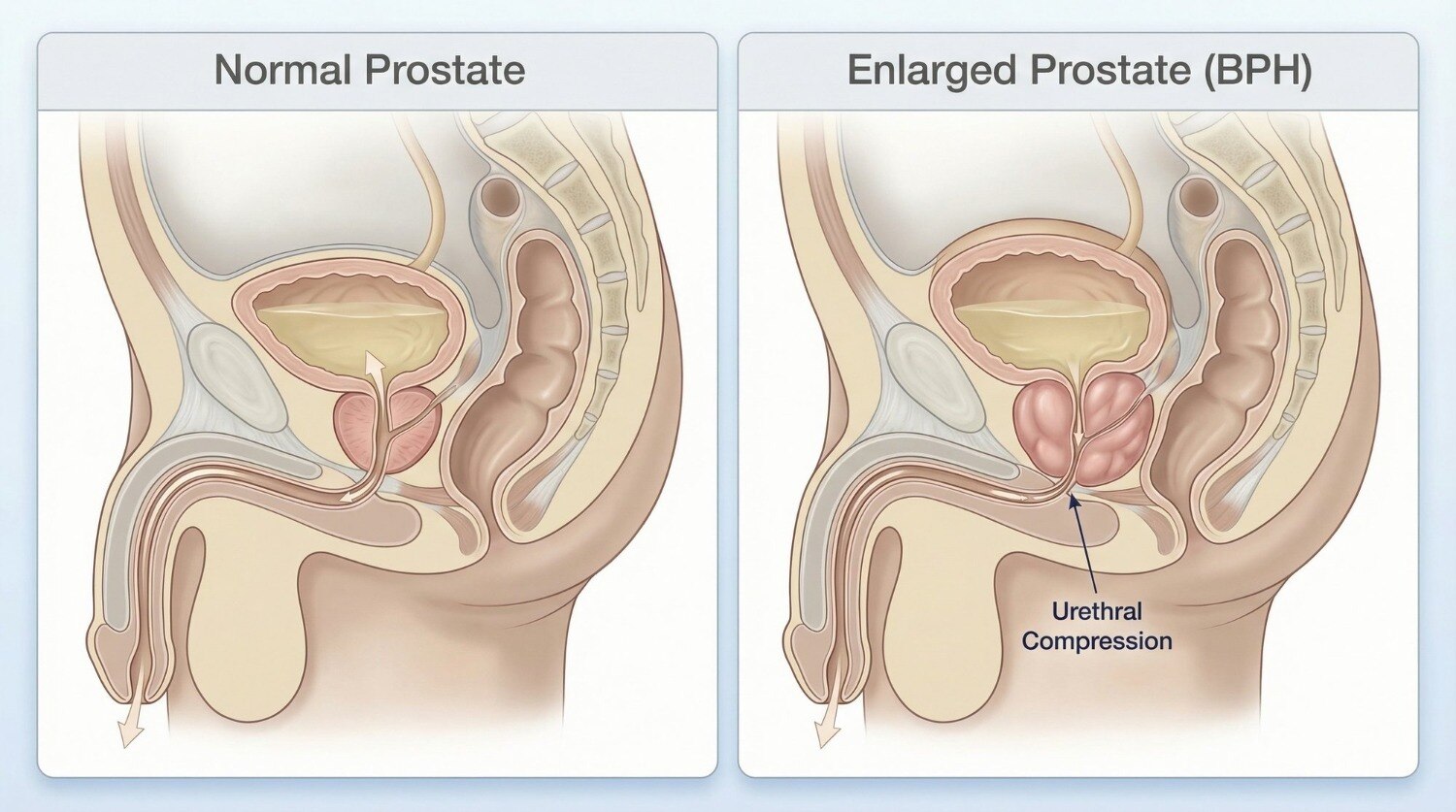
Benign prostate tissue can narrow the urethra, forcing the bladder to work harder and changing both how urine is stored and how it leaves the body. By the end, you will be able to sort symptoms into useful patterns, recognise warning signs, prepare for an evaluation and understand why prostate size alone does not determine the problem.
Key takeaways
- An enlarged prostate can narrow the urethra and weaken the urine stream.
- Bladder muscles may thicken and become overactive when emptying stays difficult.
- Burning, blood, pain, or sudden symptoms need evaluation for other causes.
- Flow testing, bladder scans, and urine tests clarify how well you empty.
How prostate tissue changes the urine stream
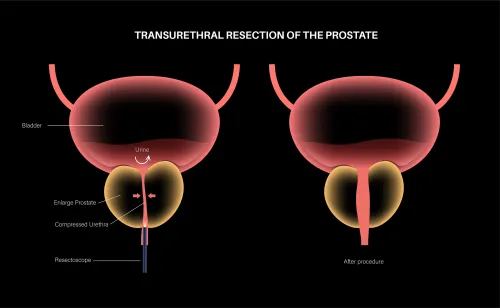
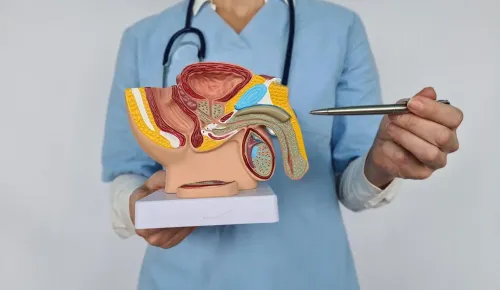
Benign prostatic hypertrophy (BPH) enlarges tissue in the transition zone around the urethra. As this tissue grows inward, prostatic urethra compression narrows the outlet and raises the resistance the bladder must overcome. Urine then leaves more slowly, even when the bladder muscle pushes harder.
| Symptom pattern | What you may notice | What it suggests |
|---|---|---|
| Storage problem | Urgency, frequent urination, nocturia, or urge leakage | The bladder is signalling a need to empty too often or too suddenly |
| Voiding problem | Hesitancy, weak stream, intermittent flow, straining, or prolonged urination | Urine is meeting resistance at the outlet |
| Incomplete emptying | Post-void dribbling, repeated trips soon after urinating, or a feeling that the bladder remains full | Urine is left behind after the stream stops |
A storage problem concerns when and how urgently urine must be held; a voiding problem concerns getting the stream started and maintaining it. Incomplete emptying is a post-micturition problem and can coexist with either group.
A small prostate can still obstruct the outlet if its tissue projects into a constricting position, while a large prostate can cause few symptoms. Symptoms alone cannot show how much urine remains or prove that BPH is the cause.
Why the bladder starts behaving differently
A bladder that must push against outlet resistance for years does not remain unchanged. Its detrusor muscle works harder to force urine through the narrowed prostatic urethra, becoming thicker and more forceful at first. That extra pressure can maintain flow while also increasing the bladder’s sensitivity to filling.
Early remodeling often produces bladder overactivity. You may feel urgency sooner, urinate more frequently or wake at night because contractions begin before the bladder is full. Reduced bladder compliance means the bladder holds less urine without a large rise in pressure, so storage symptoms become more disruptive.
Over time, sustained strain can impair the detrusor muscle’s contractility. The bladder then contracts less effectively, leaving more residual urine after voiding. Sensation can also become unreliable: some people feel persistent fullness and repeated urges, while others notice less warning despite incomplete emptying.
Prostate size and obstruction are related, but size alone does not determine the result. A large prostate can leave a reasonably open outlet if its tissue does not constrict the urethra; a smaller prostate can obstruct substantially when tissue projects into the bladder neck or the outlet is functionally tight.
The bladder’s strength, compliance and sensitivity also shape symptoms, so two people with similar prostate measurements can have very different urinary problems.
When similar urinary symptoms have another cause
A weak stream does not prove BPH is responsible. The timing, accompanying symptoms and medication list matter more than prostate size alone. Use this comparison to identify clues that point elsewhere:
| Cause | Clues that suggest another cause | What to check |
|---|---|---|
| Urinary tract infection | Burning, cloudy or foul-smelling urine, sudden urgency, fever | Urinalysis and urine culture |
| Bladder stones | Pain at the end of urination, interrupted flow, visible blood | Urine test and imaging |
| Urethral stricture | Spraying stream, narrowing after catheterisation, injury or a sexually transmitted infection | Urology examination and flow testing |
| Diabetes | Large urine volumes, thirst, fatigue and nocturia, especially with a normal stream | Blood glucose and HbA1c |
| Overactive bladder | Urgency, frequent small voids or urge leakage without infection; flow may remain strong | Bladder diary and post-void residual |
| Prostatitis | Pelvic or perineal pain, painful ejaculation, fever or tender prostate | Examination, urine testing and prompt treatment |
| Prostate cancer | Blood in urine or semen, abnormal examination, or unexplained weight or bone pain; early disease can have no symptoms | PSA discussion and examination |
| Medication effects | Diuretics increase urine production; antihistamines, decongestants and some bladder medicines can worsen emptying | Review every prescription and supplement |
Seek prompt care for inability to urinate, fever with urinary symptoms, flank pain, vomiting, severe pelvic pain or visible blood. Recurrent infections, worsening retention, or new leg weakness also need medical assessment because obstruction, bladder stones or kidney involvement can cause lasting damage.
What an evaluation can reveal about emptying
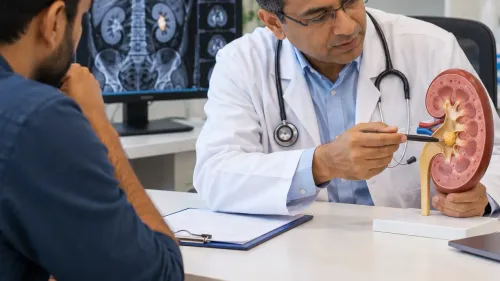
An evaluation can show whether urine flow is limited at the outlet, the bladder is contracting weakly, or another condition is driving symptoms. Before the appointment, record several days in a urination diary: times and approximate volumes, urinary frequency, urgency, leakage, nocturia, stream interruptions, straining, dribbling, and whether you feel emptied.
1. Describe the timeline and pattern. Report weak stream, hesitancy, painful urination, blood, recurrent infections, excessive thirst, constipation, and episodes of inability to urinate. Bring every medicine and supplement, including decongestants and antihistamines, diuretics, and sleep medicines; some alter bladder function or tighten the outlet.
2. Expect an examination that checks for prostate enlargement, a distended bladder, constipation, genital or urethral problems, and neurological findings affecting bladder control. An enlarged prostate supports possible BPH but does not prove it caused the symptoms.
3. Urine testing looks for infection, blood, glucose and other clues to stones or diabetes. A urine culture helps when infection is suspected; treating presumed BPH without checking urine can miss the actual cause.
4. A post-void residual measures urine left after urination, usually with bladder ultrasound or a catheter. A high result supports incomplete emptying, not a stand-alone diagnosis: obstruction, weak bladder contraction, or both can produce it.
A small residual does not disprove your sensation of poor emptying, so flow testing or further studies can resolve conflicting findings.
Choosing treatment when storage and emptying problems overlap
Clinicians base BPH treatment decisions on the dominant symptoms, prostate size, post-void residual (PVR), flow rate, medications, and complications—not on prostate size alone.
| Option | Best fit | Key limitation |
|---|---|---|
| Alpha-blocker | Weak stream, hesitancy, straining, or slow flow needing relatively quick relief | Relaxes the outlet but does not shrink the prostate or reliably prevent progression |
| 5-alpha-reductase inhibitor | A clearly enlarged prostate, supported by examination, imaging, or PSA | Works slowly, may cause sexual adverse effects, and is not an instant treatment for retention |
| Bladder-directed medicine | Urgency, frequency, nocturia, or urge leakage after clinicians assess emptying | Does not remove fixed obstruction; it can worsen retention when PVR is high |
| Procedure | Persistent obstruction, recurrent infection, stones, bleeding, kidney effects, medication failure, or acute urinary retention | Requires procedural recovery and may not eliminate bladder overactivity |
An alpha-blocker may improve flow while urgency continues because long-standing obstruction can leave the bladder overactive or poorly compliant. Relieving the outlet does not immediately reverse those muscle and sensation changes.
Bladder-directed medicines require particular caution when emptying is weak. A clinician may recheck PVR after starting treatment, especially if the stream worsens or the bladder feels constantly full.
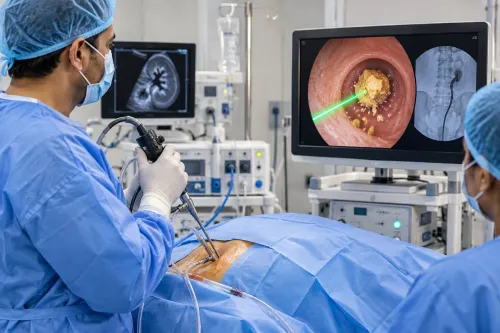
At Dr. Vivek Jadhav Laser Stone and Urology Clinic, deciding whether an endoscopic or laser prostate procedure fits involves matching the obstruction evidence and bladder behaviour, rather than treating urgency alone. Painful inability to pass urine with lower-abdominal swelling is acute urinary retention and needs urgent assessment.
Related service
Complete endoscopic Prostate surgery with laser Complete endoscopic Prostate surgery with laser Complete endoscopic Prostate surgery with laser A complete endoscopic prostate surgery typically refers to a minimally invasive procedure known as... View service → |
Frequently asked questions
How does BPH change the urine stream?
BPH enlarges tissue around the urethra, narrowing the outlet and increasing the resistance the bladder must overcome. Urine leaves more slowly, often producing a weak or interrupted stream.
Why can BPH change bladder behaviour?
The bladder muscle works harder against the narrowed outlet. Over time, this can affect storage and emptying, causing urgency, frequency, nighttime urination, or residual urine after voiding.
What other conditions can cause symptoms like BPH?
Urinary infection, bladder stones, urethral narrowing, prostatitis, medicines, neurological conditions, and prostate cancer can produce similar urinary symptoms. An evaluation helps distinguish them.
How can an evaluation show whether the bladder is emptying?
A clinician may use a symptom history, urine test, flow-rate measurement, and bladder scan after urination to measure residual urine. Further tests depend on the findings.
What happens when storage and emptying problems occur together?
Treatment must address both the narrowed outlet and bladder symptoms. A clinician may compare medicines, behavioural changes, and procedures based on residual urine, symptom pattern, prostate findings, and overall health.